THE CONFERENCE
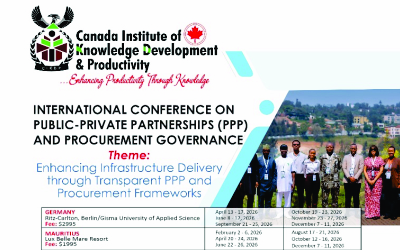
The International Conference on Public-Private Partnerships (PPP) and Procurement Governance is a high-level global forum designed to strengthen institutional capacity, promote accountability, and improve infrastructure delivery through transparent and efficient PPP and procurement systems. In an era marked by fiscal constraints, evolving regulatory demands, and growing infrastructure gaps, governments and private investors must work collaboratively to ensure sustainable and value-driven project implementation.
This conference brings together policymakers, procurement professionals, infrastructure developers, financial experts, legal practitioners, and institutional leaders to explore innovative approaches to structuring, managing, and governing PPP projects. It will address critical issues such as regulatory harmonization, contract management, risk allocation, performance monitoring, and stakeholder accountability in public procurement processes.
Through expert-led sessions, case studies, and interactive dialogues, participants will gain practical insights into global best practices in PPP governance, sustainable contracting, and transparent infrastructure delivery models. The discussions will also focus on digital procurement, ethical compliance, and the integration of value-for-money frameworks to enhance project outcomes and ensure equitable service delivery.
By uniting public and private sector perspectives, this conference aims to foster collaborative frameworks that improve public trust, attract investment, and strengthen governance in infrastructure development. Ultimately, it seeks to position PPP and procurement as catalysts for national growth, economic competitiveness, and inclusive development.
By the end of the conference, participants will be able to:
▪ understand the key principles of PPP frameworks and procurement governance for sustainable infrastructure development;
▪ apply international standards and best practices to improve transparency, accountability, and value for money in PPP transactions;
▪ design and implement effective project planning, evaluation, and contract management frameworks that ensure equitable partnerships between public and private sectors;
▪ strengthen institutional capacity to mitigate risks, manage performance, and ensure compliance throughout the project lifecycle;
▪ utilize digital procurement systems and data-driven approaches to enhance efficiency and oversight in infrastructure delivery;
▪ develop strategies to balance public interest and private sector incentives in financing and maintaining large-scale projects;
▪ promote ethical leadership, stakeholder engagement, and regulatory harmonization to foster public trust and investor confidence;
▪ analyze real-world case studies of successful PPP initiatives and procurement reforms across different sectors and regions; and
▪ formulate actionable plans to institutionalize transparent governance mechanisms for improved national infrastructure outcomes.
WHO SHOULD ATTEND
The program is particularly relevant to:
▪ Ministers, Permanent Secretaries, and Directors from Ministries of Finance, Planning, Works, Infrastructure, and Public Procurement
▪ Heads of PPP Units, Project Implementation Teams, and Public Investment Departments
▪ Procurement Directors, Contract Managers, and Tender Board Members
▪ Policy Makers, Development Planners, and Fiscal Strategy Officers
▪ Senior Executives from Construction, Energy, and Infrastructure Companies
▪ Representatives from Development Banks, Donor Agencies, and Investment Institutions
▪ Legal Advisors and Regulatory Officials involved in PPP and procurement governance
▪ Monitoring and Evaluation (M&E) Specialists and Public-Sector Auditors
▪ Defense and Security Procurement Officers responsible for infrastructure and logistics planning
ORGANIZATIONAL BENEFITS
Through this program, organizations will:
▪ Strengthen Institutional Capacity: Build the technical and managerial capabilities of teams responsible for planning, executing, and supervising PPP and procurement projects.
▪ Enhance Transparency and Accountability: Adopt global best practices and compliance mechanisms that reinforce integrity and public confidence in project delivery.
▪ Improve Project Efficiency and Value for Money: Gain the tools to design and manage infrastructure initiatives that optimize cost, quality, and long-term sustainability.
▪ Promote Effective Public-Private Collaboration: Learn partnership frameworks that balance public goals with private sector efficiency and innovation.
▪ Advance Digital Procurement and Governance Systems: Integrate e-procurement and digital oversight tools to improve traceability, monitoring, and service quality.
▪ Strengthen Financial and Risk Management: Improve the organization’s capacity to identify, evaluate, and mitigate fiscal and contractual risks in PPP projects.
▪ Foster Ethical Leadership and Regulatory Compliance: Institutionalize a culture of transparency, fairness, and responsibility across all procurement processes.
▪ Build Strategic Networks and Partnerships: Connect with international experts, donors, investors, and government representatives to facilitate cooperation and joint initiatives.
▪ Contribute to Sustainable Infrastructure and Development Goals: Align institutional operations with global agendas such as the UN SDGs and national economic transformation strategies.
CONFERENCE CONTENT
Module 1: Foundations of PPP and Procurement Governance
• Understanding PPP models, structures, and implementation frameworks.
• Exploring the principles of transparency, accountability, and value for money.
• Strengthening institutional and regulatory systems for sustainable PPP operations.
• Aligning procurement reforms with global development and investment standards.
Module 2: Legal, Policy, and Institutional Frameworks for PPPs
• Reviewing national and international PPP laws and policies.
• Developing institutional arrangements for project governance and oversight.
• Understanding contract design, bidding, and approval processes.
• Ensuring compliance, fairness, and ethical conduct in PPP transactions.
Module 3: Financial Management, Risk Allocation, and Value Analysis
• Structuring PPP financing mechanisms and assessing financial sustainability.
• Identifying, allocating, and mitigating risks in PPP contracts.
• Conducting cost-benefit and value-for-money analyses in infrastructure projects.
• Engaging private capital effectively through sound fiscal and legal frameworks.
Module 4: Procurement Systems, Transparency, and Digital Governance
• Strengthening public procurement processes to promote integrity and efficiency.
• Leveraging digital platforms and e-procurement tools for real-time oversight.
• Managing supplier performance and monitoring contract implementation.
• Enhancing accountability and traceability through digital innovation.
Module 5: Project Planning, Implementation, and Performance Evaluation
• Integrating project planning with procurement and PPP execution cycles.
• Establishing measurable indicators for project outcomes and sustainability.
• Monitoring project performance and ensuring adherence to timelines and budgets.
• Institutionalizing lessons learned and post-project evaluations for continuous improvement.
Module 6: Stakeholder Engagement and Ethical Leadership in PPPs
• Building collaborative partnerships between public, private, and civil society actors.
• Managing stakeholder expectations and communication.
• Fostering ethical decision-making and leadership integrity in project delivery.
• Enhancing public confidence through transparency and responsiveness.
Module 7: Global Best Practices and Case Studies in PPP and Procurement Governance
• Examining successful PPP and procurement reform models from leading economies.
• Learning from regional and sector-specific infrastructure initiatives.
• Sharing experiences on innovative financing, governance, and monitoring tools.
• Developing institutional action plans for implementation and reform at the national level.
What will i learn?
Available dates
- June 30 - July 4, 2026. August 18-22, 2026 September 1-5, 2026 November 17-21, 2026 December 15-19, 2026 January 12-16, 2027